
Three Committees, Three Different Answers on One Destroyer Line
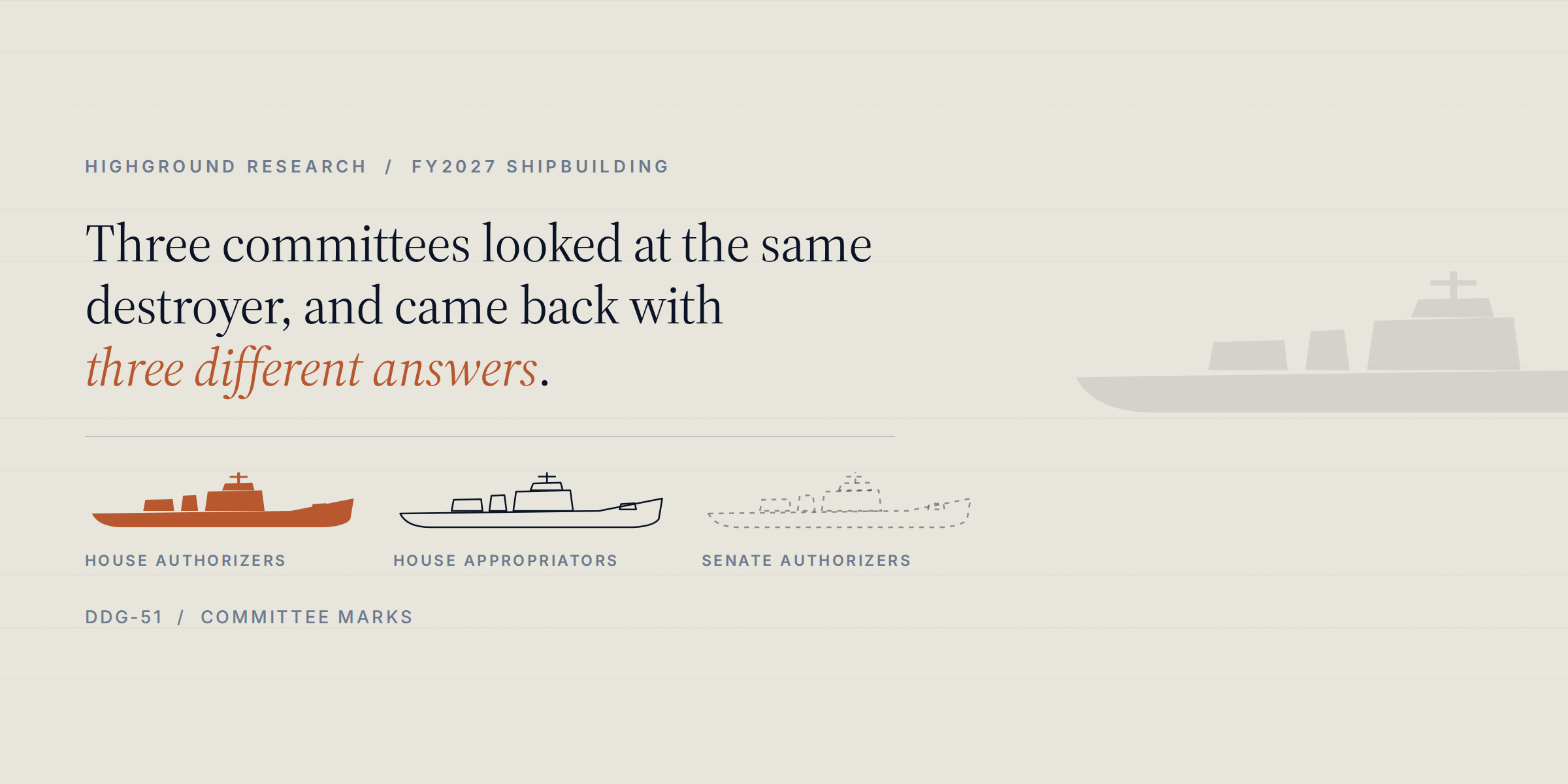
House authorizers added a billion dollars to DDG-51. House appropriators funded it as requested. Senate authorizers marked it at zero.
Three of the four congressional defense committees have now marked the FY2027 budget. Senate appropriators have not yet acted. Since there is no conference report and no enacted number, everything below describes a position.
At the account level, the positions look unremarkable. Measured against the lines each committee actually touched, counting only lines that carried a request, House appropriators came in $13.4 billion below the request on procurement, Senate authorizers $13.8 billion below, and House authorizers $1.1 billion above. House appropriators also added $3.3 billion to lines the budget never requested; counted in, their net is $10.1 billion below rather than $13.4 billion. However, open the DDG-51 destroyer line, and that picture falls apart.
The request for DDG-51 is $2,954.2 million. That is the construction line for the ship itself; a separate advance procurement line carries roughly $314 million more, and no committee position on it appears in the data below. House authorizers marked it at $3,954.2 million. House appropriators funded it at the requested level. Senate authorizers marked it at zero. Three committees looked at the same ship in the same fiscal year, and came back with a billion-dollar add, a match to the request, and a flat zero.
The House number arrived in two steps. The chairman's mark added $500 million to begin a second destroyer, then a floor amendment added another $500 million for that hull at Bath Iron Works. Published accounts of the mark citing $3.45 billion only captured the first step, not the second. The House then passed its FY2027 NDAA by a vote of 216 to 212 with the additional destroyer included. That floor vote makes the authorizer position firmer than a committee mark that has not reached the floor.
Reading the Senate zero
The Senate zero is the number that requires careful reading, because zeros in budget data are rare and ambiguous. Across 740 FY2027 procurement lines carrying a request, Senate authorizers marked exactly nine at zero. House authorizers marked one. House appropriators marked eight. A zero is a deliberate entry, but on its own it's also an unreadable one. A committee that killed a program and a committee that expects it funded elsewhere both produce the same figure: $0.00.
Three of the nine Senate zeros sit in Shipbuilding and Conversion, Navy. Each has a different story behind it. The BBG(X) battleship advance procurement line, requested at $1 billion, is a straightforward disagreement. Senate authorizers placed no restrictions on the program but declined to authorize the procurement on the grounds that it was too early. House authorizers took the opposite position and kept the money, defeating an amendment to strip it by a vote of 26 to 30. The reasoning is already public. It's simply two chambers disagreeing about timing.
TAGOS surveillance ships tell a different story. Against a $610.7 million request, House authorizers marked $580.7 million, House appropriators marked $377 million, and Senate authorizers marked zero. Three committees moved in the same direction at different speeds, with the Senate at the far end. The funding history does not explain why. TAGOS carried lines above $500 million in both FY2024 and FY2026, and the program has been spending against them. The T-AGOS 25 construction contract obligated $113.9 million in FY2023 and $516.5 million in FY2024, against an FY2024 appropriation of $513.5 million. Execution tracks the appropriation almost exactly, so a program spending slower than the budget assumed is not the explanation here. Whatever moved the Senate to zero is not visible in the funding line.
That leaves DDG-51 as the only Navy zero where relocation to reconciliation is even available as an explanation. The FY2027 reconciliation request covers sixteen ships, including two DDG-51 destroyers. Neither the battleship nor the surveillance ship appears on that list, so the relocation reading does not apply to them. The other six Senate zeros sit outside shipbuilding entirely, in Defense-Wide procurement, Air Force accounts, and Army aircraft, where the reconciliation explanation carries no weight.
There is precedent for exactly this kind of confusion. In the FY2026 cycle, the Navy wanted to fund additional destroyers and a second Virginia-class boat through reconciliation instead of the annual process. Committees disagreed, and ultimately provided more discretionary money than the department had requested for those ships.
Columbia class shows the same ambiguity. Senate authorizers cut the main production line from $10,233.8 million to $3,329 million, a reduction of 67 percent. At the same time, they funded the advance procurement at the full request. Both House committees funded the main line in full. Cutting a production line by two-thirds while fully funding the advance procurement that feeds it points toward a committee changing the funding vehicle while leaving the program itself untouched. But the table itself cannot settle the question. DDG-51 cannot be read the same way, because its advance procurement is not marked in this data. Whether the Senate treated that line as it treated Columbia's is simply unknown.
Where the committees agree
Virginia class, by contrast, is the one major combatant where the committees agree. The request of $8,402.3 million drew concurrence from both House committees and Senate authorizers to the dollar. Advance procurement at $4,143.6 million concurred across the board. That line is settled.
The submarine tender is the most interesting convergence in the data. The AS tender was requested at $4,444 million. House authorizers marked it at $3,564 million. House appropriators marked it at $2,222 million, and Senate authorizers marked it at $2,344 million. Two committees working independently, with no coordination mechanism between them, landed within $122 million of each other at roughly half the request. The shape reads as funding one hull instead of two.
Two committees, two methods
The committees themselves work in visibly different ways. Senate authorizers touched very few lines. Across all procurement, they cut 21 lines by $17.5 billion and added to 33, leaving 675 of the 729 lines they recorded a position on exactly at the request. Shipbuilding absorbed most of the reduction. Outside the Navy, the notable cuts were Conventional Prompt Strike halved to $375.2 million, the Ground Moving Target Indicator down $213.2 million, and THAAD procurement down $173.7 million against a $907.2 million request.
House appropriators moved 222 procurement lines and 274 research lines. Their largest cuts outside shipbuilding included P-8A Poseidon down $2,165.5 million, the Air Force Special Update Program down $1,702.3 million, and two Army command-and-control lines zeroed at $1,581.9 million and $1,293.2 million. XM30 dropped from $547 million to $33.1 million. One committee picked a handful of programs and made large adjustments. The other went line by line through the entire book.
One caution applies in both directions. Where a committee's number matches the request exactly, the data cannot distinguish genuine concurrence from a line the committee never reviewed. The same limitation that makes the zeros hard to read applies just as much to the concurrences too.
Virginia class is settled across three committees. The submarine tender is close to settled at half its request. DDG-51 and Columbia carry a real, unresolved disagreement into conference, and the meaning of that disagreement depends entirely on whether the Senate zeros reflect elimination or relocation. The budget data shows three committee positions on the destroyer line. Getting the reasoning behind them means going past the table, into committee reports and staff positions not captured in the numbers alone. For anyone underwriting a shipbuilder or pricing the conference outcome, the reasoning is the piece that matters.