
A Third of the FY27 Defense Research Budget Rides on a Bill That Has Not Passed
The FY27 defense research budget shows 140% growth. Most of it is $124.9B in reconciliation money Congress has not appropriated, across 35 program elements.
The 140 percent growth figure circulating in defense circles is real. About 85 points of it reflect a change in how the Pentagon prints its books.
The FY2027 defense research budget arrived this spring with a topline growth figure that defense analysts and Hill staffers have been passing around ever since. Nearly 140 percent growth over the prior year. The number reproduces from the comptroller's own tables. About 85 points of it also trace to a single new row in the justification books, labeled "FY 2027 mandatory request," that did not appear in last year's edition. That row holds $124.9 billion in reconciliation money across 35 program elements. Congress has not yet appropriated it, and the comptroller chose to display it inside the budget book alongside the discretionary request.
The distinction matters because it changes what the growth figure actually describes. Compare discretionary spending against discretionary spending and the year-over-year increase is 49 percent, which is still enormous by any recent standard. Compare last year's discretionary total, which excluded reconciliation, against this year's printed total, which now includes it, and you get 140 percent. Both numbers are accurate, but only one of them measures a change in how much money Congress is spending on defense research. The other measures a change in how the Pentagon displays money that Congress has not yet appropriated.
Last year's books had reconciliation money too. It was printed under a different label, "FY 2026 PL 119-21 spend plan," naming the statute directly, at $65.46 billion. In both years, discretionary plus reconciliation equals the printed total to the dollar across every program element in both books.
The other comparisons tell a more measured story. Total spending against total spending grew 62 percent. Reconciliation against reconciliation grew 91 percent, a figure that says something about how fast the administration proposes expanding the pool of defense money it routes outside the normal appropriations process. Forty-nine percent discretionary growth is still an enormous year for defense research, larger than anything in the post-sequestration era. But the difference between 49 percent and 140 percent is the difference between a big appropriations year and a structural change in how the Pentagon accounts for its money.
Where the money actually sits
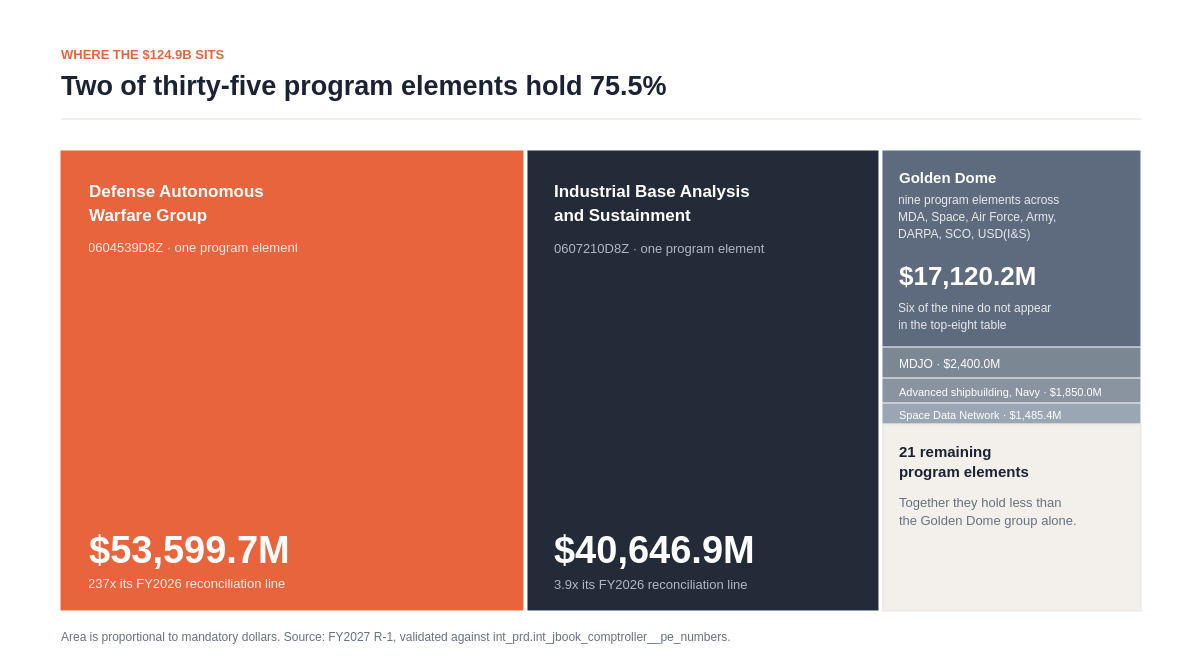
Thirty-five program elements carry the $124.90B. Two of them hold $94,247M, which is 75.5% of it.
The money is not spread equally among the thirty-five. The Defense Autonomous Warfare Group, a program element that carried $225.9 million in FY2026, all of it reconciliation, holds $53.6 billion. Industrial Base Analysis and Sustainment Support carries another $40.6 billion. After those two, the Golden Dome missile defense entries combine for about $17.1 billion across nine separate program elements. Everything else is comparatively small. The Space Data Network requests $1.5 billion. An advanced shipbuilding line in the Navy requests $1.85 billion. The concentration is striking even by the standards of a defense budget that has always been top-heavy.
The Industrial Base line deserves particular attention because it reveals how reconciliation money was allocated. This program recorded $342 million in actual spending in FY2022. Since then, its discretionary request has run between $273 million and $1.10 billion, and its FY2027 discretionary request of $1.18 billion sits right in line with that history. Nothing about the program's trajectory changed. What changed is that the reconciliation money in the same row went from $10.5 billion to $40.6 billion. Whoever reads the justification book sees a familiar line carrying an unfamiliar sum, and the book itself offers no decomposition of what that $40.6 billion will buy.
That opacity extends across the full $124.9 billion. The money is requested against program elements that name no vendor and no platform. When the Pentagon awards contracts against these funds, the spending will begin appearing in federal procurement records. Those records are where the money becomes attributable to specific companies, specific systems, and specific delivery timelines. For now, $125 billion sits in program lines that describe capability areas in broad terms and nothing more.
For anyone watching the appropriations calendar, though, the reconciliation money carries an exposure the rest of the research budget does not. Everything in the discretionary bill faces the annual fight over continuing resolutions and shutdown politics. The $124.9 billion faces that fight and one more behind it. It needs an FY2027 budget resolution Congress has not adopted, and then a reconciliation bill nobody has drafted. The House resolution passed in July carries $60 billion for defense against a $350 billion request. In a fiscal year where the CR fight has consumed most of the oxygen in Washington's budget conversation, 36.2 percent of the printed defense research account depends on a vehicle that does not yet exist. Where it lands when the contracts are signed is the second question. The first is whether the contracts happen.
Send us a coverage list or a set of target programs. We reply within one business day.