
The Fastest-Growing Line in the FY27 Budget Is Not a Program
Defense Production Act purchases ran about a billion dollars a year. The FY2027 request is $30.4 billion. Nobody knows who gets it yet, and that is not a research failure.
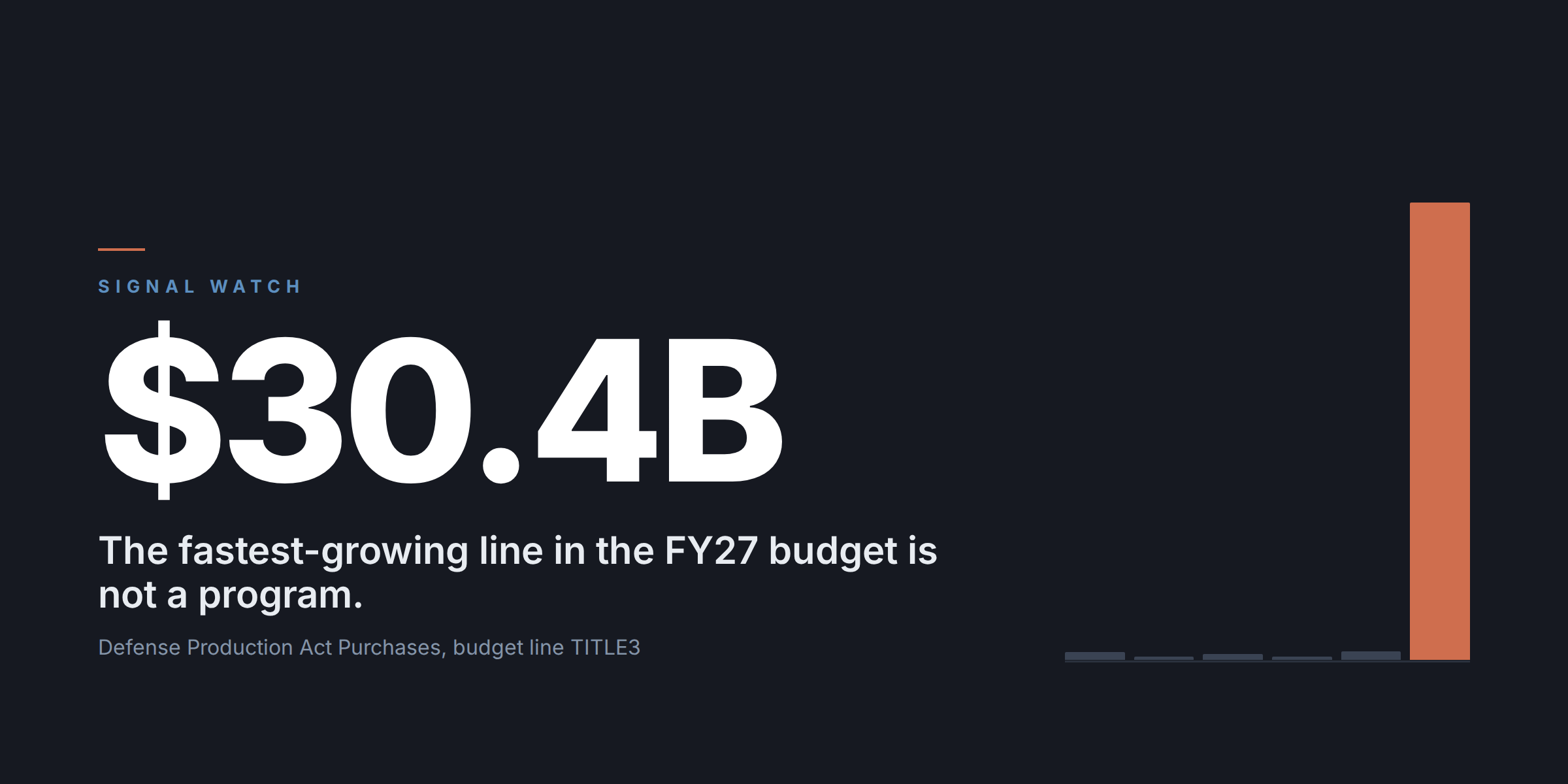
For years, reading the defense budget meant reading program names. The F-35 had a line. The Virginia-class submarine had a line. If you wanted to know where the money was going, you found the program and followed the number next to it. This year, the single largest dollar increase in the entire FY2027 procurement book belongs to a line that works differently. It is called Defense Production Act Purchases, labeled TITLE3 in the budget tables, and known to everyone in the building as Title III. Until this year, it ran about a billion dollars annually. Its FY2027 request is $30.4 billion. No other procurement line in the book moved like that.
Title III is not a program. It is an authority, the mechanism the department uses to purchase domestic production capacity in materials and components it has decided it cannot afford to import. Critical minerals sit inside it. So does a great deal that has not been specified, because the specification happens later, at contract award, generally two to three years after appropriation. Authorities do not come with supplier bases. They have whatever the department later decides to point them at.
This creates a problem for anyone trying to read the FY2027 budget as a map of where defense spending is going. Rank the budget by market growth and Title III surfaces inside a category called strategic materials development, which climbs from $2 billion to $30.8 billion. Read that as a market signal and you might conclude that a specific industry is about to receive an enormous infusion of capital. What actually happened is that the department requested a very large sum for a legal authority, and the authority does not yet have a list of recipients. This is also why searching the budget for a rare earth processing line comes up empty. There is no such line. The money that will eventually buy rare earth processing capacity is sitting inside Title III, undifferentiated, alongside whatever else the authority gets used for.
The same flaw runs through the rest of the top-growth rankings. One entry is nonsense: an FY2026 base of $6.4 million producing a growth rate near 35,000 percent that tells you nothing about spending trends. Another is budget line 9999, which prints in the source tables as "GRAND TOTAL" and "Classified Programs," a rollup that someone mapped to a market category. A third is an industrial base research program filed under facilities. Strip those out and three categories survive an actual audit, all above $20 billion in FY2027 and all traceable to named budget lines.
The first is hypersonic defensive systems at $33.4 billion. But more than a third of that total, $12.3 billion, sits in the MSE Missile line, with Conventional Prompt Strike and the MD14 line behind it. A PAC-3 variant sitting inside a category labeled for hypersonic defense says more about how the taxonomy was built than about the threat it describes.
The second is strategic materials development at $30.8 billion. That is Title III wearing a market label, with nearly the whole category riding on the single authority.
The third is the one that actually holds together under scrutiny. Precision munitions, at $21.7 billion, is spread across Standard Missile, Tomahawk, Mid-Range Capability, JASSM, AMRAAM, Precision Strike Missile, and LRASM. Every dollar traces back to a named weapon that is already in the field or well into production. For context, fighter aircraft grew 15.9 percent this year, a good year rather than a step change, and amphibious warfare systems declined 9.8 percent.
The decomposition of Title III into actual contracts is a procurement event, not a budget event, and it runs on its own timeline. That money becomes awards to specific processors, refiners, fabricators, and manufacturers, one action at a time, generally two or three years after Congress appropriates it. Some of it will go to companies that already hold federal work. A meaningful share will go to companies that have never had a federal contract, because the purpose of the authority is to create production capacity that does not currently exist.
Nobody can tell you today who wins $30.4 billion. The awards have not been made. What can be said is where the spending becomes visible first. The federal award record will show it in pieces, starting whenever the first contract actions post. That record will precede any filing or earnings call. For a budget line this size, the gap between appropriation and attribution could easily run into 2029.
The split is in the book. Of the $30.4 billion, $477.3 million is discretionary and $29.95 billion is mandatory, requested through reconciliation. That puts 98 percent of the line on a bill that has not passed. Procurement carries mandatory funding across this cycle. Our own analysis of THAAD found $10.5 billion of mandatory money on a single Army procurement line. Title III is more concentrated than that, and the concentration matters because mandatory money that is requested rather than enacted carries a different kind of risk than money Congress has already passed into law.
Send us a coverage list or a set of target programs. We reply within one business day.