
The HighGround Marks Dataset Shows How Congress Actually Moves Money
Every committee action is published with a number and a stated reason. Read as a series, they show which programs Congress protects.
Every committee action is published with a number and a stated reason. Read as a series, they show which programs Congress protects.
A defense budget request is just one institution's opening position. What happens to it next plays out as a public negotiation over the following nine months. It is conducted in writing, with dollar figures attached to every line. Almost nobody reads it that way, as a dataset, but they should. Four committees weigh in on the defense budget each year. Two decide whether to authorize, and two decide whether to appropriate. Each publishes its own position on individual budget lines, along with the rationale for the ones it changes. Conference committees reconcile each pair of positions and an appropriations act enacts a final number. Every step leaves a paper trail, and that record goes back seven cycles.
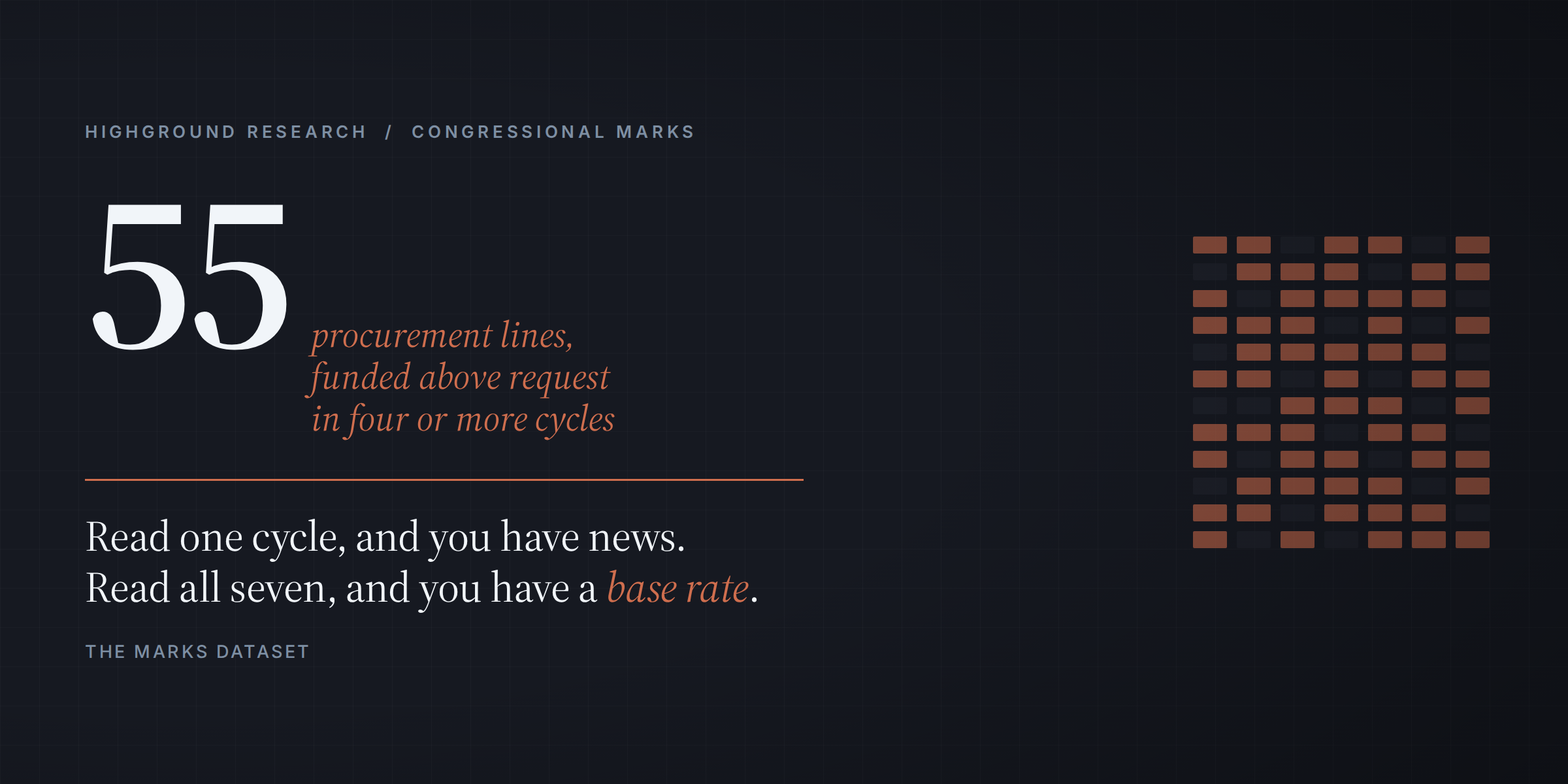
Read one cycle, and you have news. Read all seven, and you have a base rate. The dataset’s most valuable signal shows up over time, in the lines that receive the same treatment year after year. Across the seven cycles, 55 procurement lines received congressional additions in four or more separate years, among them the C-130J airlift line, the Combat Rescue Helicopter, and the Paladin Integrated Management. All three appeared again in the FY2027 House appropriations mark, receiving $300 million, $215 million, and $577 million above the request. When Congress adds money to the same line across four or more cycles, it funds it for a reason that does not reset each budget year. Committee reports usually state that reason. For anyone trying to determine whether a request understates what a program will actually receive, that multi-year history is the strongest available predictor. It is also invisible to anyone who reads only the current year.
The dataset is imperfect, and the imperfections run in specific directions that matter.
Where a committee's published number matches the request exactly, the record cannot tell you why. The committee could have looked at the line and agreed with it, or just never touched it. This means any serious analysis has to report where the money moved, and stay quiet about lines that appear unchanged. The appearance of agreement and actual agreement produce the same entry. It also means that summing a committee's positions across lines it did not mark will understate its real total. That arithmetic error is how a real $15 billion gap between two authorizing committees can appear as $46.5 billion in an analysis that does not account for coverage.
The problem runs the other direction on zeros. A line marked at $0.00 can mean a committee eliminated a program or expects the program to be funded through a different vehicle. Both produce the same entry on the page. Distinguishing them requires the report language, as the DDG-51 analysis in this series showed.
The four committee positions cannot be added together. Each is an independent judgment against the same request, not sequential adjustments to a running total. Summing them overstates congressional movement by a factor of three in a typical cycle. And on the request side, procurement lines are missing the published request value in one cycle, FY2026, often enough to distort that year’s aggregate. Line-level committee actions and enacted finals hold up.
These limitations are real, and they define what the dataset can responsibly say. They do not diminish the reason to read it, because a line that four committees fund together is still the strongest predictor available.
Committee marks are published months before the conference and roughly a year before the money reaches a contract. A program that all four committees have funded is close to being settled well before enactment. A program with one committee behind it and another cutting it is carrying risk that the request alone will never show you. That risk is visible in August, months before the defense firms report the revenue, and years before the appropriation translates into contract obligations. The gap between when a decision becomes visible in the congressional record and when it shows up in reported earnings is the entire reason to read this data as a series rather than as a single year's snapshot.